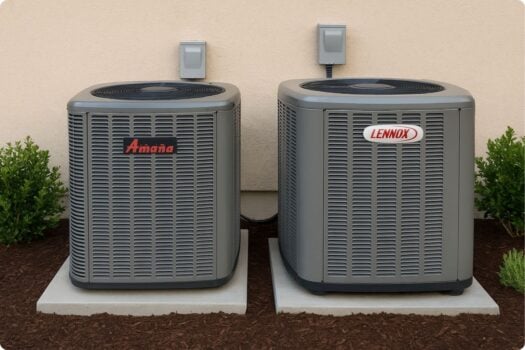
When homeowners start comparing Amana vs Lennox, they’re usually trying to answer one practical question: Which brand will give me the best balance of price, reliability, efficiency, and long-term value for my climate and budget? This guide walks you through that decision with clear, data-aware explanations — not marketing fluff.
You’ll get a quick verdict, side-by-side comparisons of efficiency (SEER/SEER2, HSPF), real warranty differences, cost-of-ownership considerations, and the installation and maintenance factors that actually determine how well a system performs in your home.
If you care most about upfront cost and simple, dependable coverage, this guide explains why Amana often appeals to value-focused buyers. If long-term operating savings, whisper-quiet operation, and top SEER performance matter more, you’ll see why Lennox frequently leads in premium lines.
Read on to find the one-page quick verdict, practical buyer profiles (budget, efficiency, noise, rentals), and a printable checklist you can hand to installers — everything you need to choose confidently and avoid buyer’s remorse.
Quick TL;DR (Read this if you want the short answer):
- Best for value & strong standard warranty: Amana — typically positioned as a value-forward brand with robust parts warranty options.
- Best for top-tier efficiency and premium features: Lennox — known for very high-SEER models, advanced comfort tech, and tiered warranty programs for premium lines.
- Best practical pick: Choose Amana if your top priorities are upfront price and a straightforward factory warranty; choose Lennox if you want maximum seasonal efficiency, the quietest operation, and are willing to pay more for premium models and dealer support.
How to use this guide
This post is a practical, people-first comparison meant for homeowners, first-time buyers, landlords, and contractors who want to choose between Amana and Lennox. It focuses on decision-making: warranty, efficiency, cost of ownership, reliability, installation, and climate fit.
If you want model-level specs, use the manufacturer links in the Sources section to verify specific numbers before purchase.
Brand snapshots — Amana vs Lennox
Amana — what they’re known for
Market position: value-oriented brand with a reputation for strong standard parts warranties and simple product lines that target budget-conscious homeowners. Amana emphasizes long parts coverage on many systems and provides online warranty registration and lookup tools.
Lennox — what they’re known for
Market position: premium-to-mid market with a clear push into ultra-high-efficiency systems and advanced comfort features (variable-capacity compressors, quiet operation). Lennox offers tiered product lines (e.g., Merit, Elite, Dave Lennox Signature® Collection) and flexible warranty options, including extended/labor coverage packages.
Head-to-Head Summary: Amana vs Lennox
| Category | Amana | Lennox |
| Typical positioning | Value / straightforward models | Premium / high-efficiency models |
| Standard parts warranty | Strong 10-year parts coverage on many models (registration varies by state) | Tiered (5–10+ years depending on product tier; heat exchangers often longer) |
| Efficiency focus | Competitive mid-range SEER options | Top-of-market SEER / SEER2 models and variable-capacity tech |
| Repair & parts availability | Good — wide dealer network for many regions | Very good — large dealer network, though premium parts may cost more |
| Best for | Budget-focused homeowners who want a strong parts warranty | Homeowners wanting maximum efficiency, quiet comfort and premium features |
| Typical contractor notes | Easier, quicker installs; less complexity for basic units | Requires careful sizing & experienced installers for variable-speed systems |
Energy efficiency — SEER, SEER2, HSPF and why they matter
What SEER means (brief): SEER = Seasonal Energy Efficiency Ratio — higher is better (lower electricity use for the same cooling). Note: the industry has been transitioning to SEER2 ratings (updated test procedures) since 2023; when comparing products, be sure you’re comparing like-for-like (SEER vs SEER2). Upgrading to higher SEER/SEER2 units usually reduces electricity bills, but actual savings depend on local energy prices and usage.
ENERGY STAR thresholds: ENERGY STAR has minimum SEER2/HSPF2 criteria for eligible central ACs and heat pumps; for example, certified split central ACs now require ≥ 15.2 SEER2. If rebates or tax credits are important, prioritize units that meet ENERGY STAR requirements.
How Amana and Lennox compare:
- Amana offers solid mid-to-high efficiency models that are attractive for buyers wanting good operating cost without premium price tags.
- Lennox often leads the market in peak efficiency and variable-capacity systems; their top-tier products are engineered to achieve the highest seasonal efficiencies, which matters for long-term operating cost if you live in a climate with heavy cooling loads.
Practical efficiency advice:
- If your utility bills are a major concern and you run cooling extensively, invest in the highest SEER/SEER2 model that fits your budget.
- If your climate has short summers and mild weather, the incremental savings may not offset the premium. Use a SEER calculator (or contractor estimate) to model yearly operating costs for your usage pattern.
Warranty — what to read, what to ask
Warranties are a big reason homeowners choose one brand over another. They’re also one of the least understood purchase drivers.
Key warranty facts
- Amana highlights 10-year limited parts coverage on many models and offers online registration & warranty lookup tools. Registration may be required in some cases to obtain full coverage — check the model’s warranty page and state-specific terms.
- Lennox uses tiered warranty protection depending on product line; compressors and heat exchangers often have longer terms in higher-tier models; Lennox also offers flexible extended coverage options known as “Warranty Your Way.” Review your product’s certificate and registration instructions carefully.
What to check on the warranty certificate
- Parts vs compressor vs heat exchanger coverage lengths.
- Whether labor is covered (most manufacturer warranties do not include labor unless you buy an extended plan).
- Registration requirements and time limits for activation.
- Maintenance clauses (does missing a yearly tune-up void coverage?).
- State limitations (some states restrict conditional warranties).
Questions to ask your contractor before signing
- Will the installation include a startup report and balance verification that most manufacturers require to keep warranty valid?
- Do you provide a written warranty for your workmanship? (You should get this in writing.)
- Will you register the unit with the manufacturer or should I? (Keep a copy of the registration/serial.)
- Who pays for freight/parts under warranty and what’s the local response time?
Initial cost vs total cost of ownership
What drives total cost: unit price + installation (labor, ductwork, permits) + operating cost (electricity) + maintenance + repairs. A higher-efficiency unit may cost more up front but lower operating costs over the life of the system.
Rule of thumb: Calculate estimated yearly energy savings with a SEER-to-energy calculation for your cooling hours/region (many online calculators can help). Because SEER2 changed test procedures, always ensure you’re comparing SEER2 numbers when models are labeled that way.
Amana vs Lennox in cost terms:
- Amana: usually lower to mid-range unit cost; good parts warranty reduces risk of mid-term part replacement expenses.
- Lennox: higher MSRP on premium models; may offer lower lifetime operating cost in hot climates due to top SEER models, but higher upfront price and potentially higher repair cost for advanced components.
Example (illustrative only): Upgrading from a 13 SEER unit to an 18 SEER2 unit in a hot climate may cut annual cooling energy by a meaningful percent — but exact dollar savings depend on electricity cost and usage. Use a SEER savings calculator or contractor estimate for region-specific numbers.
Reliability, parts availability & serviceability
How to judge reliability: Combine manufacturer reputation, owner reviews, technician experience, and AHRI certification data. AHRI maintains a directory of certified product performance that ensures the unit meets published specs — use it to confirm claims.
Practical points:
- Amana units are typically straightforward, with widely available replacement parts — this can speed repairs and keep labor costs predictable.
- Lennox offers broad dealer support and parts availability worldwide, but high-end parts (variable compressors, advanced control boards) may be more expensive and require manufacturer-trained technicians.
Local check: Call 2–3 HVAC shops in your area. Ask them which brand they install most, typical parts lead times, and their experience with warranty claim handling. This simple step often reveals real-world serviceability differences that matter more than headline specs.
Noise, comfort features & indoor air quality
Noise: Variable-speed compressors and insulated cabinets reduce noise. Lennox’s top models often focus on the quietest operation through multi-stage compressors and advanced insulation; Amana offers quiet mid-range units that are fine for typical homes. Verify decibel (dB) ratings for specific models if noise is a critical factor.
Comfort features to consider:
- Variable-speed blowers/compressors (better temperature control & humidity management)
- Zoning compatibility (for multi-zone homes)
- Dehumidification performance (important in hot-humid climates)
- Smart thermostat compatibility (connected features vary by model)
If comfort/humidity control is a priority, favor systems with variable-capacity compressors (often found in Lennox’s higher-tier lines), but insist on precise installation and commissioning to realize those benefits.
Installation quality — the single biggest performance factor
An excellent installer can make a mid-range unit outperform a poorly installed premium system. Key installation items to demand:
- Proper sizing (Manual J load calc) — not rule-of-thumb sizing.
- Correct refrigerant charge and airflow balancing (Static pressure checks).
- Ductwork inspection and sealing.
- Startup / commissioning report and a walk-through explaining maintenance.
If you ignore one piece of guidance here, let it be this: choose the installer first — then choose the brand. A highly competent contractor minimizes warranty issues and maximizes efficiency in the field.
Climate fit — match the brand/model to your weather
- Hot, humid climates: Prioritize high SEER/SEER2, good dehumidification, and durable condensers — Lennox’s high-SEER systems can offer tangible savings.
- Hot, dry climates: High SEER still helps; dehumidification is less critical.
- Cold climates: Heat pump HSPF/HSPF2 ratings and cold-climate performance matter; ENERGY STAR and manufacturer cold-climate designations help pick models that perform well in low temps.
- Mixed climates: Look for balanced performance — efficient cooling and capable heating modes (or a good furnace pairing).
Read More: Amana Vs. Whirlpool Appliances: What Are The Major Differences?
Model recommendations by buyer profile
These are conservative, profile-based suggestions. Verify model-level specs with manufacturer pages and local pricing.
- Budget buyer / value: Consider Amana mid-range AC + standard furnace. Expect a solid parts warranty and good basic performance. Ask for a clear written workmanship warranty.
- Efficiency-first homeowner: Consider Lennox Elite or Dave Lennox Signature® Collection variable-capacity models if your climate and budget justify the extra upfront cost; they tend to offer the best SEER/SEER2 numbers. Get a detailed operating-cost estimate from your contractor.
- Noise/comfort-focused: Lean toward models with variable-speed compressors (commonly offered in Lennox premium models). Confirm dB ratings and ask for a site visit to evaluate outdoor unit placement.
- Cold-climate buyer: Verify HSPF/HSPF2 ratings and cold-climate designations from ENERGY STAR and manufacturer specs; pair heat pumps with supplemental heat or high-efficiency furnaces where appropriate.
- Landlords / rentals: Choose reliability and low maintenance. Amana’s simpler models and straightforward warranties can be attractive for rental properties.
Real-world performance & owner feedback (how to research it)
To assemble real-world insight:
- Read aggregated reviews (Consumer Reports, verified owner reviews).
- Check HVAC forums and local Facebook groups for repair patterns.
- Ask 2–3 local technicians about brand-specific recurring issues and parts lead times.
- Use AHRI to confirm rated performance.
Common themes you’ll see: Amana owners praise value & warranty; Lennox owners highlight efficiency and quiet operation but report higher initial cost and sometimes costlier repairs for premium components.
Read More: Are Kitchen Aid Appliances Good : The Ultimate Guide
Maintenance checklist (simple, high-impact)
Follow this seasonal list to maximize life and warranty compliance:
- Replace filters every 1–3 months.
- Clean outdoor coil and keep 2–3 feet clearance.
- Have professional tune-up annually (AC in spring, furnace/heat pump in fall).
- Keep condensation lines clear and inspect drain pans.
- Keep records of maintenance and invoices (necessary for warranty claims).
A basic maintenance plan prevents many common failures and protects warranty eligibility.
Rebates, incentives & financing
- Look for ENERGY STAR rebates on qualifying high-efficiency models — check federal, state, and local utility programs. ENERGY STAR specs and links help identify eligible equipment.
- Many manufacturers and dealers offer financing and seasonal promotions. Ask your contractor to include available rebates in the cost estimate.
- For larger efficiency upgrades, check current federal tax credits or utility-sponsored rebates for heat pumps and high-SEER systems (programs change, so verify current eligibility before purchase).
Decision flow — quick checklist before you buy
- Prioritize: budget vs operating cost vs comfort.
- Confirm your climate needs (cooling-heavy vs heating-heavy).
- Choose features you value (variable speed, zoning, dehumidification).
- Shortlist brands/models — verify SEER2/HSPF2 with AHRI/manufacturer.
- Get at least 3 written quotes (including startup/commissioning details).
- Check warranty certificate and registration requirements.
Pros & Cons — side-by-side
Amana — Pros
- Better value on many models
- Consistent 10-year parts coverage on many products
- Simpler systems can mean quicker, cheaper repairs
Amana — Cons
- Fewer ultra-high-efficiency models compared with Lennox
- Fewer premium comfort features
Lennox — Pros
- Leadership in top SEER/SEER2 efficiency and quiet operation
- Tiered product lines for matching needs and budgets
- Strong dealer support and optional extended warranties
Lennox — Cons
- Higher upfront price for premium lines
- Advanced systems may cost more to repair
Read More: Amana vs Whirlpool Washing Machine: Which Brand Is Better for You?
FAQs
Is Lennox better than Amana?
It depends on priorities. Lennox typically leads in top efficiency and comfort features; Amana often offers stronger value and simpler ownership. Both are reputable — choose based on features, budget, and installer quality.
Which brand has the better warranty?
Both have solid warranty programs, but coverage varies by product line and region. Amana highlights 10-year parts coverage on many models; Lennox offers tiered coverage and extended options — read the specific product certificate.
Do I need to register my unit to keep the warranty?
Sometimes — check the manufacturer’s warranty terms. Both brands provide online registration tools; some states limit conditional warranties. Always retain your purchase and installation records.
Final recommendation — how I’d choose
If you want the best chance of low upfront cost and a straightforward parts warranty: choose Amana and pair it with a competent local installer who provides a workmanship warranty and a clear startup report.
If you want the quietest ride, top SEER performance, and are willing to pay more upfront for long-term operating savings (especially in hot climates): choose Lennox but insist on a highly experienced installer to properly commission the system.